Impact
These OpenOakland projects have either reached their intended conclusion or been handed off to a partner for long-term management. Because most of our work is open source, these projects can often be reproduced or adapted by anyone with an interest in doing so.
Is your organization facing a challenge like the ones below? Partner with us
Looking for what we’re working on right now? Visit Current Projects.
Delivered
Volunteer Database
With over 2,000 volunteers in our network, OpenOakland needed a reliable way to capture people’s skills, experience, and availability and match them to the right projects. A volunteer team built a lightweight database system - a public intake form, self-service profile editing, QR-code meeting check-in, and project tracking - that a non-technical admin can maintain. Matching a volunteer to a project used to take months, and sometimes never happened at all. It now takes one to two weeks. Read the full story in A New Database for OpenOakland’s 2,000 Volunteers.
Delivered
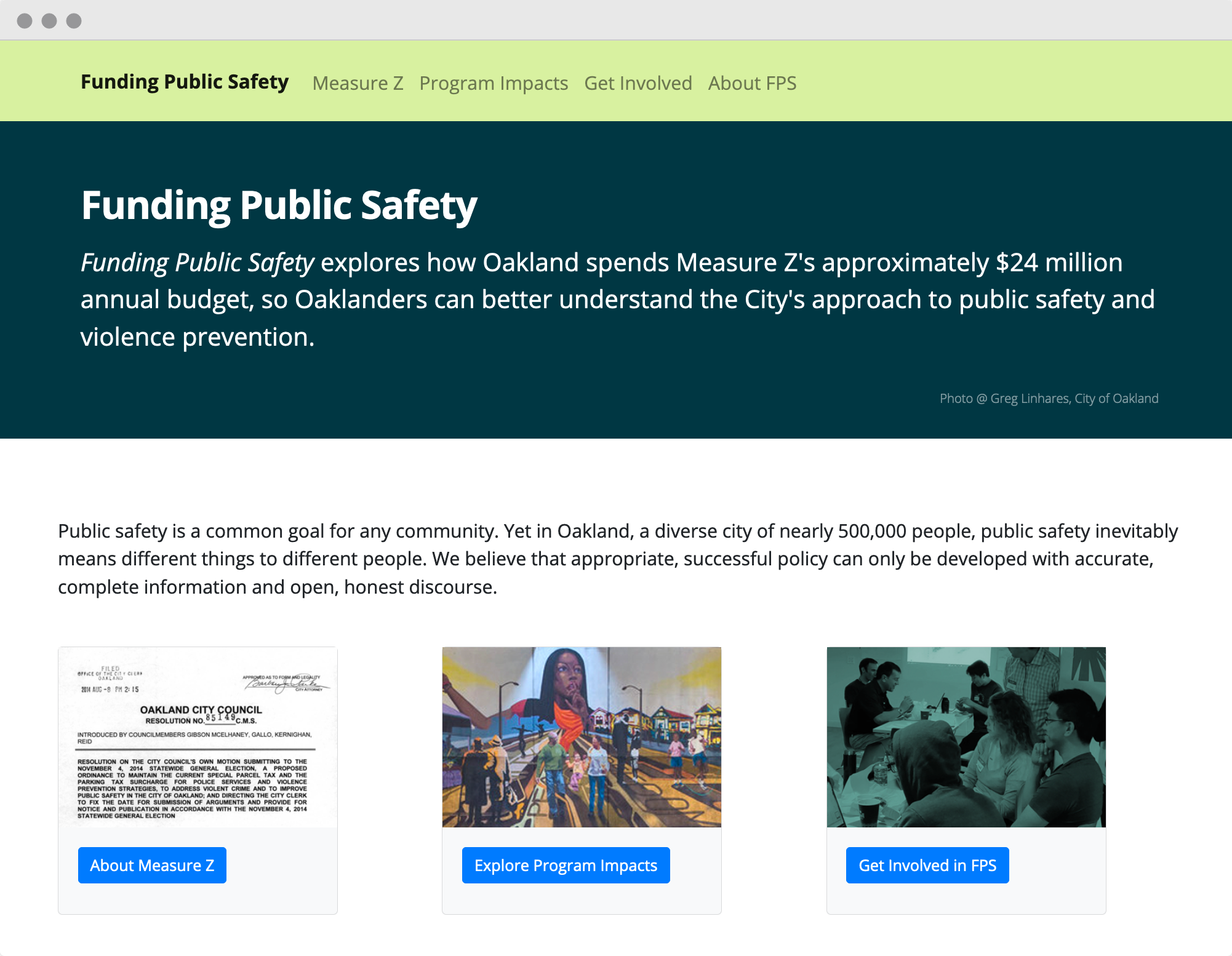
Funding Public Safety
Oakland’s Public Safety and Services Oversight Commission (SSOC) is tasked with monitoring how the City spends Measure Z funds, aimed at reducing violence by funding community policing, and violence interruption and prevention programs. In the summer of 2021, members of the SSOC approached OpenOakland for support making sense of the data they were receiving from the City in anticipation of their funding recommendations to City Council at the end of the year. OpenOakland helped them identify key questions and goals, understand the scope of available data and its limitations, and prepared them to make their recommendations with confidence. The team then prepared for a potential phase 2 of the project, involving a public website housing the information they learned and exploring Oakland’s public safety issues in more depth. A key component of this was identifying potential community stakeholders and impacted populations for further engagement in shared decision-making and project design should the project continue.
Delivered
La Escuelita
OUSD doesn’t provide resources for school websites, but many parents (and parents of prospective students) expect them to. La Escuelita, a K-8 elementary school in the Lake Merritt area, wants help developing a simple website that goes live in Fall 2020 term; houses essential info like announcements, schedule changes (currently rely on paper fliers students bring home) and contact info; offers easy-to-use technology and a layout that non-technical staff can easily update and maintain.
Delivered
Oakland Beats
This tool helps visitors determine which Community Police Beat they live in. In Oakland, Neighborhood Councils (formerly known as Neighborhood Crime Prevention Council or NCPC), operate for each of the 53 Community Police Beats. The Neighborhood Council system provides a way for residents to gather and discuss local crime problems with a city and OPD representative on a monthly basis.
Connect on Slack
#project-oak-crime
Delivered
Oakland Art Murmur
OpenOakland partnered with Oakland Art Murmur to build tools that art enthusiasts could use to promote Oakland art. At the heart of this partnership was Art Murmur’s interactive Art Map. The map featured a series of curated walking tours. Clicking along the tour route revealed photographs of public art in Oakland with accompanying information about the artwork. The team built a submission form that allowed anyone to submit new art to the map by leveraging Oakland Wiki.
Delivered
Water Quality
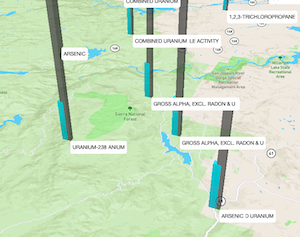
Approximately one million California residents currently only have access to drinking water that does not meet state and federal standards. The California Drinking Water project provides user-friendly online queries, charts, and maps to show which water systems have current and persistent drinking water contamination violations. Partnering with the State Water Board and the Community Water Center non-profit organization, Open Oakland volunteers developed a tool features using the State’s bi-monthly Human Right to Water water quality reporting data on cities, communities, schools, and daycares. The online features allow government officials, advocates, researchers, and residents to more easily understand which water systems have contamination problems and identify solutions that support clean water for all Californians. Used daily by local grassroots organizations, the site won awards at two consecutive Water Data Challenges.
Project lead
Open, formerly Aaron Hans
Connect on Slack
#project-ca-water-challenge
Delivered
Discount Mobility Share
Discount Mobility helped low income residents get access to scooter share, bike share and car share programs. While every company has discount programs for low income residents, the application process is fragmented and these benefits aren’t widely known. We unified the application for these programs and engaged in outreach so people were aware of this benefit.
Delivered
Alameda County Census 2020 Landing Page
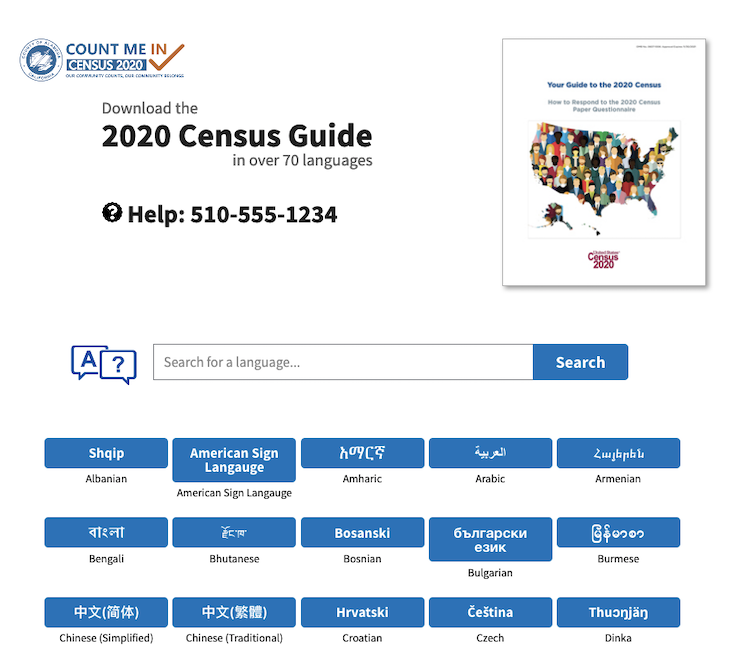
This landing page was a portal for the 2020 Census administered by Alameda County. It will be accessible at locations where a computer or tablet is provided to the public and is intended to introduce people to the Census and offer information in their native language about why the Census is important to complete, as well as resources and guides on how to complete the Census. It is intended to be welcoming to people for whom English is not their first language.
Delivered
Open Oasis
Phase III focused on developing a survey design, and related questionnaire, to measure OTX impact across their tech literacy programs servicing individuals in public housing. The data team fine-tuned our Phase II deliveries to be “publication-ready”, while our volunteers leading the survey design work partnered with CUT group to assist with the survey design, implementation approach, and language of questions.
Delivered
Alameda County Census 2020 Events
Census partners can submit events (workshops, tabling, drop-in centers, etc) and resources around the 2020 census. Alameda County residents can learn more about the first all digital census through these events, even finding locations where they can get assistance to complete the census. Residents can search for events based on date, location, and language.
Delivered
CannaEquity.org
In 2017, City of Oakland expanded their medical cannabis licensing to include regulation for cultivation and manufacturing. As part of this activity, the City also codified an Equity Licensing Program to address barriers to participation in the industry for members of disenfranchised communities in Oakland. This program includes a provision for “equity business incubators” to support new businesses in the industry. Equity businesses in the pipeline will be important to regular applicants, because regular licenses will only be issued on a one-to-one basis with equity licenses during the initial phase of the program. The incubator opportunity is intended to help new enterprises overcome the barrier of securing commercial space by incentivizing more established businesses to agree to share their existing space for a minimum of three years. By partnering with an equity business, a regular applicant will be moved to the top of the list for the next available non-equity cannabis business license. To support the Equity Licensing Program, OpenOakland provided support to other volunteer technologists and cannabis entrepreneurs working with the City of Oakland’s City Administrator’s Office and the Department of Race and Equity to develop CannaEquity.org, an online “matchmaking” application that would assist interested equity and regular applicants to locate each other efficiently. Applicants would create online accounts to pre-screen for compatibility and control the pace of information sharing and relationship building needed for the formation of space-sharing relationships. The app will be maintained until the end of phase one of licensing. This date will be determined by the collection of cannabis tax revenue sufficient to launch the next phase of equity applicant support services (assumed to be within one year).

Project lead
Formerly Angela Gennino and Richard Ng
Delivered
RecordTrac
RecordTrac was a simple way for individuals to submit public record requests to a governmental agency online. The application, built in 2013, also allowed government employees to manage, respond to, and fulfill incoming requests. By displaying all submitted records requests, members of the public can find what they need without having to create a new public record request.
Delivered
Track G – Oakland’s Measure G
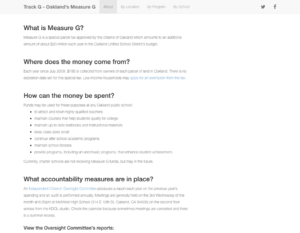
Measure G is a city ballot measure that was passed by the citizens of Oakland in 2008 to improve the quality of education provided by Oakland public schools. Money is collected from Measure G via a special parcel tax, which amounts to about $20 million a year in additional funds for the Oakland Unified School District’s budget. Track G – Oakland’s Measure G publishes data on how funds collected from the Measure G parcel tax are spent. Track G allows spending to be seen by location, by program, and by school.
Project lead
Formerly John Baldo, Erin Hancock
Connect on Slack
#project-track-g
Delivered
Adopt a Drain
Adopt a Drain was a platform for Oakland residents to volunteer to be responsible for keeping a nearby storm drain clear to decrease flooding from storms, protect water quality, and keep trash from storm drains and connected creeks and water bodies. Vigilant maintenance of the City’s storm drain infrastructure is important for reducing pollution in the Bay. Adopt a Drain was set up in partnership with City of Oakland’s Public Works Agency.
Delivered
Soft Story
Soft Story is a simple interactive map of potential soft-story buildings in Oakland. Soft-story buildings are multi-unit, wood-frame, residential buildings with a first story that lacks adequate strength or stiffness to prevent leaning or collapse in an earthquake. These buildings pose a safety risk to tenants and occupants, a financial risk to owners, and risk the recovery of the city and region. This data shows the results of a screening program for potential soft-story buildings in Oakland. In 2008 Oakland surveyed its multi-family buildings with five or more units, and in 2009 passed an ordinance that required the owners of these buildings to complete a simple evaluation of the ground floor. This data shows the results of these screenings as of early 2013.
Connect on Slack
#project-soft-story
Delivered
Early Oakland
Built in partnership with the Oak Education Cabinet in 2011, Early Oakland provided information on early learning programs that were state subsidized and federally supported Head Start programs in Oakland, including Bananas Child Care Resource and Referral, Oakland Head Start and the Unity Council Preschool, as well as Oakland Unified School District Early Childhood Education Department. It included part-day and full-day programs for three- and four-year-olds, and a few programs also served younger children.
Delivered
Open Government Pledge
During Oakland‘s 2012 elections, OpenOakland asked electoral candidates to take the Open Government Pledge to support three core principles of Open Government: transparency, participation, and collaboration. By the end of the elections, four of the six winners had signed onto the pledge.